If you want to get some better times on your strava segments here's our top tips used by the KOM club team.
It's always advisable to research the segment first rather than winging it. This way you'll know how long it is, the power you are going to need and where it starts and finishes. There are many segments that don't finish at the top of the hill as you'd expect but a few hundred yards later.
There are some very easy wins with your bike setup, the right tyre pressure, tyres, inner tubes, tubless can all make a big difference. Firstly and well free, is tyre pressures there are loads of calculators out there that do the hard work for you like the Silca tyre pressure calculator. Enter your weight, tyre size etc and it will calculate your ideal pressures for front and rear
The next stage costs money and it's tyres and tubes (or tubeless if you like it messy) Personally I've got Continental GP5000 with latex inner tubes, but there are loads of good options out there, have a look at the excellent Bicycle Rolling Resistance website if you really want to get into it. Some people love tubeless and you can get good results with them but personally, I've been on rides with so many people where it's failed and they are covered in sealant waiting for a lift on the side of the road. Each to their own.
If you've got old school rim brakes on your hill climbing beast then I'd open up the brake adjusters a bit, especially on the rear as when you're giving it the full beans the bike frame and wheel can flex a bit and this can cause the brakes to bind slightly. It's easiest to do the with the quick brake adjuster (the ones you open to get clearance for wheel removal) - just remember to do them back up again before the descent! The front does not tend to have this issue, so for safety you may as well leave that in case you forget to tighten after all the excitement of getting your KOM! Obviously use this tip with caution
Now for the science, if you've got a power meter it's quite a bit easier as you can use it to meter out your power at the correct level for the segment (to hopefully get the KOM!)
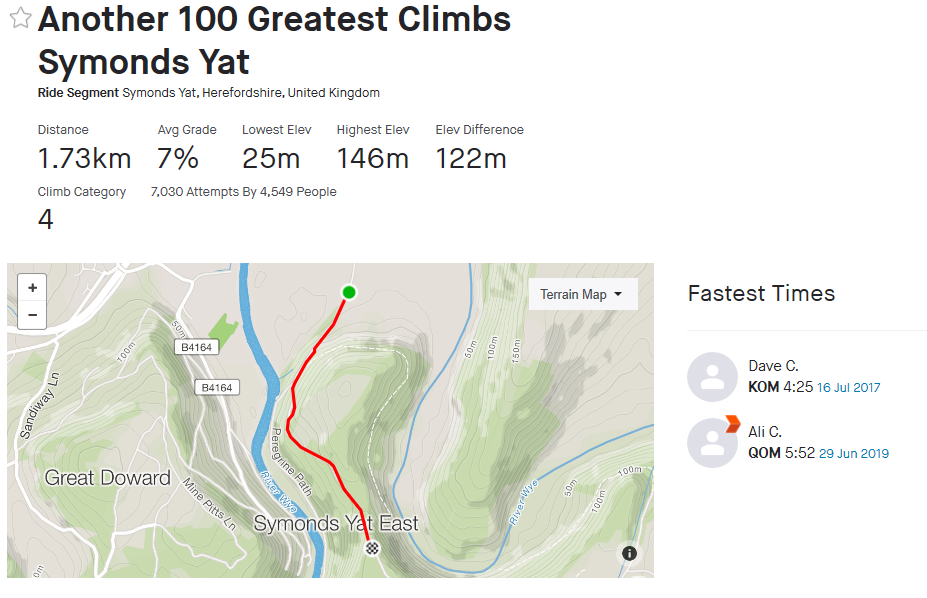
On your chosen Strava segment, look to see the time the current KOM / QOM has.
As you can see on our chosen segment Dave C has the KOM at 4:25 mins. Ali C has the QOM at 5:52. Now look at your power curve (Strava Summit members or other software)
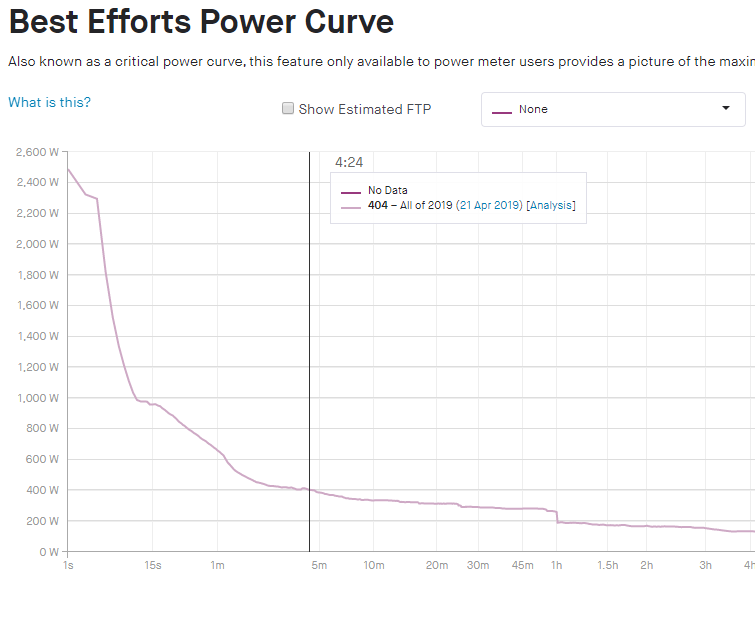
Look along the X-axis to 4:25 mins (KOM time) Then look up to see what power you can maintain over that period of time. So you can see in this example from my power curve for 4:25 mins is 404W. This is the power I'd attempt to ride the segment at. It's always advisable to try and hold that power for the whole segment rather than getting too carried away at the start as your power will die at the end and you're unlikely to do a good time.
Now, you may not be as strong as the rider that has the KOM/QOM but using this method is a good guide to power you should use to give you the best chance. On shorter segments your FTP (functional threshold power) would be much too low as your power over short distances will be much higher.
Eat breakfast - there are many nutrition guides out there on this. I tend to stick to porridge / muesli and avoid anything hard to digest.
Check your bike - the obvious stuff like lubing the chain and pumping the tyres up. Also take off any excess weight won't need. Don't be tempted to put it in your jersey pocket instead - that's not going to help ;) Keep your clothing as lightweight as possible too.
For a 1 min effort I'd recommend at least 30 min warm up. To get the best results I'd do this with some structure. The simplest one to remember is going up in thirds of your FTP, so say your FTP is 300W ride 5mins at 100W then 200W and finally 300W. Do this twice to complete the warm up. I'd also throw a few max effort sprints in (5 secs long)
If this sounds like a bit of a faff just use your ride out to the segment as a warm up but I'd still chuck in a few short sprint efforts to warm everything up a bit.
If you feel you might need a gel, take it 15 mins before the start of the segment.
Firstly know where the start and finish points are. You want to go through the start point at speed so get things going a bit before.
If it's a shorter segment try to maintain the power you calculated for the segment during your research. The trick is to maintain the power as constantly as you can, don't be tempted to dig in and massively exceed your target power on any of the steep parts as you'll probably have to recover mid segment and that's always slower.
If you are doing a longer segment you'll be basically riding it at your FTP. Try not exceed 33% over your FTP on any part as again this is likely to cause you to want to recover during the segment.
The terrain often varies during the segment and you'll want to maintain your power so if it flattens off keep selecting a big gear to push into or pick up your cadence. Don't be tempted to use the flatter sections for recovery.
Now, keep an eye out for the end of the segment for a strong finish! Push through the finish point and slightly beyond to allow for any GPS glitches.
Well, that's it! I hope this helps
KOM Team
Keep up to date with our news, updates and cycling activiy by following our social media and joining our Strava club.